












The Revolution Will Be Certified
What Came Before the Cut
Before the new image, there was already a familiar one: candles in the dark, careful faces, old slogans polished until they could pass for memory. The streets had long since emptied, but the story kept walking. It learned how to wear dignity like a good coat and how to make sacrifice look tidy under studio lights. People who had risked something once were invited back again and again, until danger itself began to sound rehearsed. That is how a country can be taught to remember itself. Not with lies, exactly. With editing.
And so the old rooms returned, the same voices, the same moral lighting, the same promise that history had chosen its rightful witnesses. But witnesses can be selected. And once a camera has made its choice, the rest of us are expected to believe the frame is the truth.
The Ballot, the Number, the Insult
Saxony-Anhalt has spoken, and the number is not a rumor: the AfD took 43.8 percent of the vote in the latest state election. That is not a seizure. That is a ballot. It was counted, not stolen. The voters did not storm the palace with pitchforks and torches. They went to the polling place and used the one instrument democracy still hands to people who have been ignored too long or lectured too often: the paper in the box.
Chancellor Friedrich Merz answered with a line that sounded cleaner than it was: “In our country, power is granted, not seized.” It is a remarkable thing to say right after an election. The sentence formally accepts the result while still dressing it in the language of warning, as if the vote itself were an act of violence. But the contradiction is sitting right there in the open. Power was granted. You simply did not like who received it.
That distinction matters. Democracy is not a permanent blessing machine. Sometimes it delivers a result that makes the established narrators reach for the alarm bell. That does not make the vote illegitimate. It makes the narrator unhappy.
The Checkout Line and the New Moral Border
And then comes the civic test that always pretends to be harmless until it starts asking for papers at the door: are AfD voters in Saxony-Anhalt still allowed to shop at dm and Rossmann? Will the stores shut down? Will the cashier ask to see the ballot before ringing up shampoo and aspirin?
No one is seriously accusing the drugstores of anything. That is not the point. The point is the moral fine print hidden inside every cheerful campaign to “go vote.” Because sometimes what is really meant is not: go and vote. Sometimes what is meant is: go and vote correctly. And once a democracy starts saying that out loud, it should at least have the decency to blush.
Charity With a Door Policy
There is also the recent case of a longtime employee at an evangelical Diakonie hospice who was dismissed after standing as a local AfD candidate. She is contesting the dismissal, so the legal outcome is not settled. But the signal sent by the institution was unmistakable. The old language of care and conscience is still there, just standing behind the curtain while the new language checks party alignment at the entrance.
When did Christian charity begin checking membership cards at the door? That is the question that hangs in the air like cigarette smoke in a chapel basement. In East Germany, institutions were always fond of the higher vocabulary: conscience, courage, sanctuary, responsibility. But the moment wording became inconvenient, the shelter could disappear. The furniture stayed. The mercy did not.
The First Disneyland of the East
I never trusted the opposition crowd around Rainer Eppelmann as much as the official mythology now requires me to pretend I should have. My distrust was personal, not doctrinal. I looked at that beer-drinking, muesli-eating congregation and saw not purity but theater. The Blues Masses and the rest of that scene felt, to me, like the first Disneyland of the East: poems read under bad light, protest songs on badly tuned guitars, everybody trying out the dangerous face for the evening while the Stasi had already bought tickets and found seats in the back row.
The Stasi was not invited. It infiltrated. That is the part the commemorative version always sandpapers smooth. Not every person in those circles was complicit, and no one serious should claim otherwise. But the myth of the safe, clean, clearly divided opposition space never survived contact with the files. The scenery was crowded. The show was watched.
Even Eppelmann himself became part of the later confusion, though he rejected the accusations that surfaced in 1990 and the historical record does not support the lazy version that turns surveillance into guilt. What is easier to prove is that he was watched, surrounded, and threatened. That is the more honest Berlin sentence anyway: not innocence, not purity, but pressure.
When Courage Met the Machine
I also distrust the annual liturgy called the Peaceful Revolution, not because the courage was fake, but because the ending has been made too neat. The courage was real. The danger was real. The candles were real. So were the truncheons, the interrogations, the fear, the rage. In October 1989, police and security forces used violence against demonstrators. On October 9 in Leipzig, the scale of the demonstration surprised the authorities. Local officials feared they were standing on a fuse that might burn straight through the country and waited for instructions from East Berlin. At the same time, the leadership was already wobbling, Honecker’s position was weakening, and Soviet non-intervention helped shape the field more than the later anniversary speeches like to admit.
So yes, the people made history. But they did not control every condition under which they were suddenly allowed to make it. That is not a small distinction. It is the part of the story the ceremony leaves out. The state did not collapse because candlelight alone defeated a heavily armed dictatorship like a hymn verse knocking over a tank. It hesitated, fractured, and lost the nerve to answer in time. History opened a door. The people walked through it. The lock had already begun to fail.
The Witness That Comes Pre-Approved
That brings us to the real defendant: the camera.
Not one person. Not one party. Not one heroic face. The camera.
When somebody is introduced on television as a “civil rights activist,” who verified the title? What was examined? What was omitted? How many times does the same introduction have to be repeated before it stops sounding like description and starts sounding like fact? The camera does more than record a witness. It selects the witness, casts the role, chooses the light, and keeps the performance on file. Then another camera repeats the same witness, the same title, the same ceremonial breath.
Year after year, the candles return. The same faces return. The same approved sorrow returns. That is how history becomes a set. Not because everything inside it is false. Because the audience is never shown who built the scenery, who approved the cast, or who remained outside the frame while the narration was being written.
Two Men, One Table, Too Much Tea
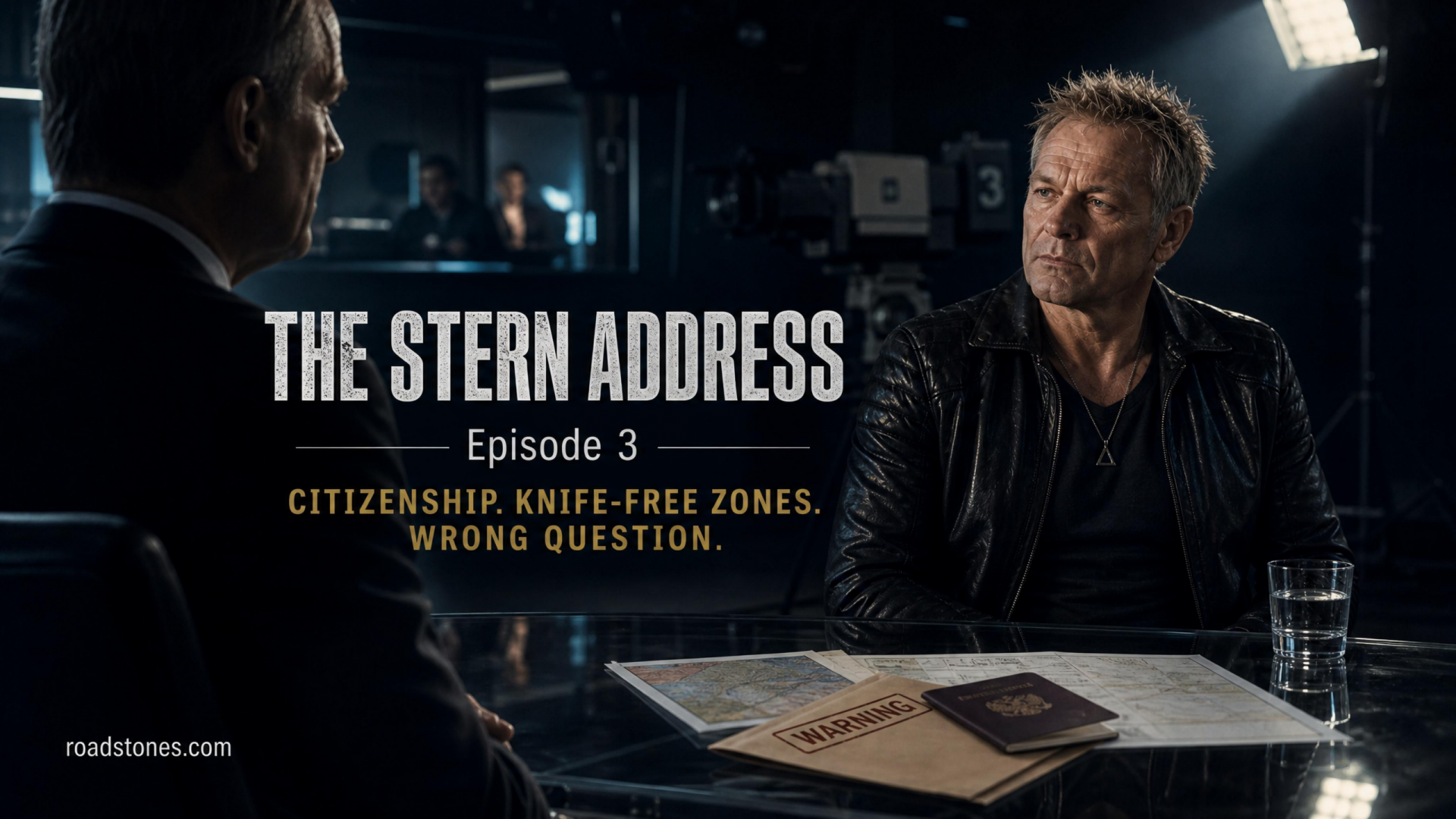
So let me give you one of those little scenes that television likes because it looks harmless.
Across from me sits a disheveled former West Berlin sixty-eighter. Faded knitted sweater. Hair still in revolutionary disorder. An old peace-dove tote bag hanging by the chair. A cup of herbal tea that looks as if it has been there since the Central Round Table and never quite forgiven itself for surviving.
The lower third says:
FORMER EAST GERMAN CIVIL RIGHTS ACTIVIST
Kreuzberg resident since 1978
I look down at the papers in my hand and say, very dryly, “You left East Germany eleven years before the revolution.”
He leans forward, solemn as a cathedral worker, and says, “Exactly. They knew I was coming.”
Another lower third appears, because the camera never met a witness it did not want to annotate:
HISTORICAL CONSULTANT
Present at every event shortly after it happened
I tell him, “According to this, you witnessed the fall of the Wall from a pub in Kreuzberg.”
He answers, without blinking, “Somebody had to observe it from the West.”
I say, “Thank you for your service.”
Radio Bremen, Undercover and Overcaffeinated
This is where Episode 2 comes back into the room. Years ago, Radio Bremen went undercover in Kreuzberg SO 36 and found cigarette smoke, political theory, badly tuned guitars, and men preparing to liberate East Germany without crossing the street. It was all so earnest, so theatrical, so wonderfully self-important that nobody could have invented it twice.
And yet decades later here they are again, same district, same stories, better titles. Lower third, same old magic:
FORMER UNDERCOVER ASSET
Radio Bremen — Kreuzberg Station
I look at the old material and say, “I knew we should have kept the receipts.”
The joke is not just that the undercover operation was absurd. It is that the absurdity helped build the recruitment office for the television version of history. Once a story learns how to look heroic on camera, it no longer has to remain complete in order to survive.
What the Vote Means When the Narrators Dislike It
And now we come back to Saxony-Anhalt, because that is where the whole argument began. The voters did not seize power. They used the only power democracy gave them. They marked a ballot, and the count returned a result the respectable class would rather not have to explain at dinner.
That does not make the vote noble. It makes it real.
The question is not whether I approve. Approval is a sentimental luxury, and history has never cared much for it. The question is whether democratic power remains legitimate when the established narrators despise the person to whom it has been granted. If the answer depends on who the camera likes, then the republic is already wearing makeup.
The ballot was counted. Then the camera began correcting it.
This is not history.
This is casting.
Autor
THE STERN ADRESS
THE CAMERA WRITES THE HISTORY
Written and Narrated by
David Stern
