



A literary-political report on the argument that missed the wound it was trying to name.
What Was Left on the Table
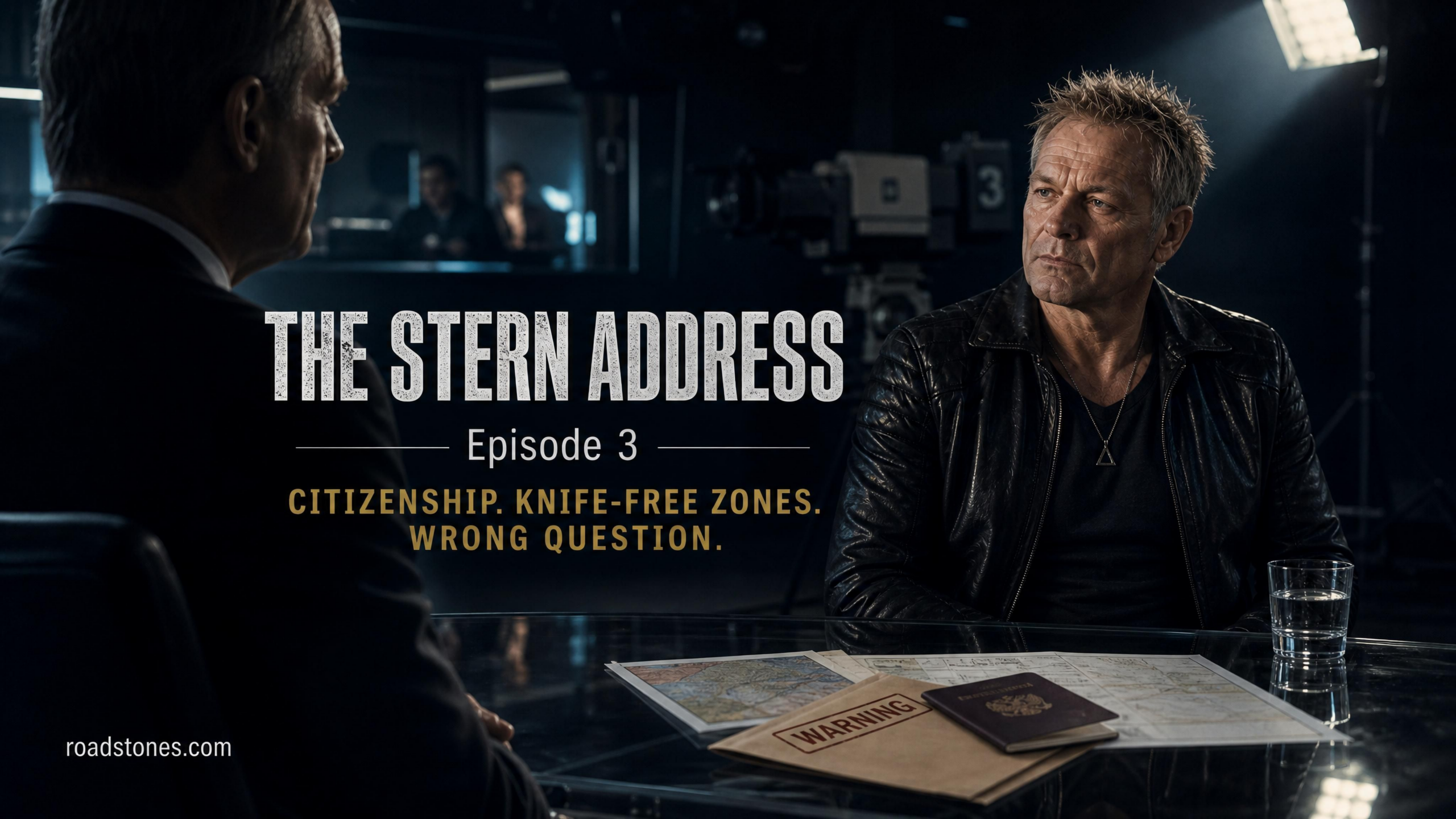
There are arguments that arrive dressed like answers and leave looking like weather. This was one of them. Two men stood inside the bright machinery of television, one from the CDU, one from the AfD, and between them lay a case no one wanted to touch for long. The subject was the Berlin CSD attack, the man accused of it, and the fact that he was not some foreign shadow drifting across the map, but a German citizen, born in Berlin, known to the authorities, already convicted for preparing a serious act of violence, and still free before the attack. That is where the real weight of the matter sat: not in the passport, not in the birthplace, but in the long and shameful distance between warning and action.
And yet the duel drifted sideways. One question reached for the neatness of a slogan, the other for the comfort of a partisan jab. Between them, the dangerous man disappeared behind a discussion about who had signed what, who had inherited which law, and whose camp should carry the blame. It was the sort of exchange that can make a room sound intelligent while it walks past the broken window.
The Wrong Question
One side asked, in essence: what citizenship should he have had, if he was born here? The sentence sounds hard until you hold it up to the light. Birth in Germany does not by itself decide nationality in every case; under German law, a child born in Germany acquires German citizenship at birth when at least one parent is German. That is the plain legal frame, and it is older, cooler, and less theatrical than television prefers. The birthplace alone was never the whole story. It was never meant to be.
The answer from the other side landed no better. In substance: who made the citizenship law? The CDU. That, too, was too blunt to be true in the way it was said. The modern jus soli element was introduced in Germany on 1 January 2000 under the red-green government, not as a gift from one conservative party, and certainly not as a magic trick that could explain this case away. What is publicly known so far does not even settle the exact legal path by which the attacker became German. If a German parent was already in the picture, the birth-place argument would not matter the way the debate pretended it did.
So the discussion swung like a loose gate in the wind: citizenship, responsibility, origin, blame. But the lock on the door was not there.
The File Nobody Opened
The sharper question was the one left untouched: why was a man already known as an Islamist threat, already convicted, still at liberty before the attack? That is the state failure with teeth in it. Not the passport. Not the place of birth. Not the easy language of expulsion, which collapses the moment the person in question is a German citizen. The state’s problem was risk management, not nationality theory; prevention, not rhetoric; the distance between what the security services knew and what they did with that knowledge.
A dangerous person does not become harmless because the debate has found a cleaner target. A warning does not discharge itself because politicians have found a better sentence. The file existed. That much was clear. The question was why it remained unopened in the only way that mattered: not by clerks, but by action.
Knife-Free Zones and Other Paper Shields
Then came the next tidy proposal: knife-free zones. A city draws a line on the map, sets hours on the clock, and tells the blade to stay outside from six in the evening until six in the morning. Such zones are not nothing. They can help police stop the impulsive, the drunk, the reckless, the young fool who brought a knife because he thought the night would need one. But a man planning murder does not check the timetable.
If he were the kind of man who obeys a sign, he would not be the kind of man the sign was meant to stop. The zone may work on the carrier who hesitates. It does not negotiate with the committed attacker. The state can forbid a blade in a district and still fail to stop the man who already entered the district as a danger.
And so the old administrative theater returns: rules, zones, forms, licenses. Another proposal followed close behind, this time aiming at the driving licence of extremists. A licence can be taken away. A steering wheel, however, does not read a file. Paper can name the threat. Paper cannot arrest him.
That is why the argument felt so off-center. It kept trying to discipline the object instead of the failure around it. The papers did not fail to identify the man. The system failed to act on what they said.
Jordan, and the Temptation of the Easy Example
There was also the Jordan example, pulled in to make a point about birth and citizenship. The instinct behind it was sound enough: being born in a country does not automatically make every person a citizen of that country. But Jordan is not a simple prop in a European argument. The official Jordanian position describes a long and complicated history in which many Palestinian refugees received Jordanian citizenship, while the legal status of others has remained distinct, shaped by origin, descent, and family history. In other words, the example works only if it is handled carefully. It can illustrate that birth alone is not destiny. It cannot be flattened into a slogan.
That is the pattern, really: whenever a difficult case is dragged into a debate built for applause, the facts begin to lose oxygen. The nationality question becomes a trapdoor. The security lapse, which should stand in the center of the stage, gets shoved into the wings.
No Team Jersey
The cleaner position is the harder one. No party gets loyalty by default. Each claim stands on its own feet or falls. That is not neutrality for its own sake; it is discipline. A party may make one sound point and one foolish one in the same hour. It may be right on a border of policy and wrong at the center of the same breath. The only honest answer is to keep the line between evidence and allegiance.

That may be an unfashionable posture in a country where every sharp sentence is expected to wear a scarf in somebody’s color. But the facts do not belong to a camp. They belong to the case.
The Real Question
Two men argued about citizenship and blame. Between them lay the thing that mattered: a known danger, a recorded threat, a state that had the warning in hand and still let the man move toward the crowd. That is where the story lives. Not in the passport. Not in the birthplace. Not in the cleverness of the last retort.
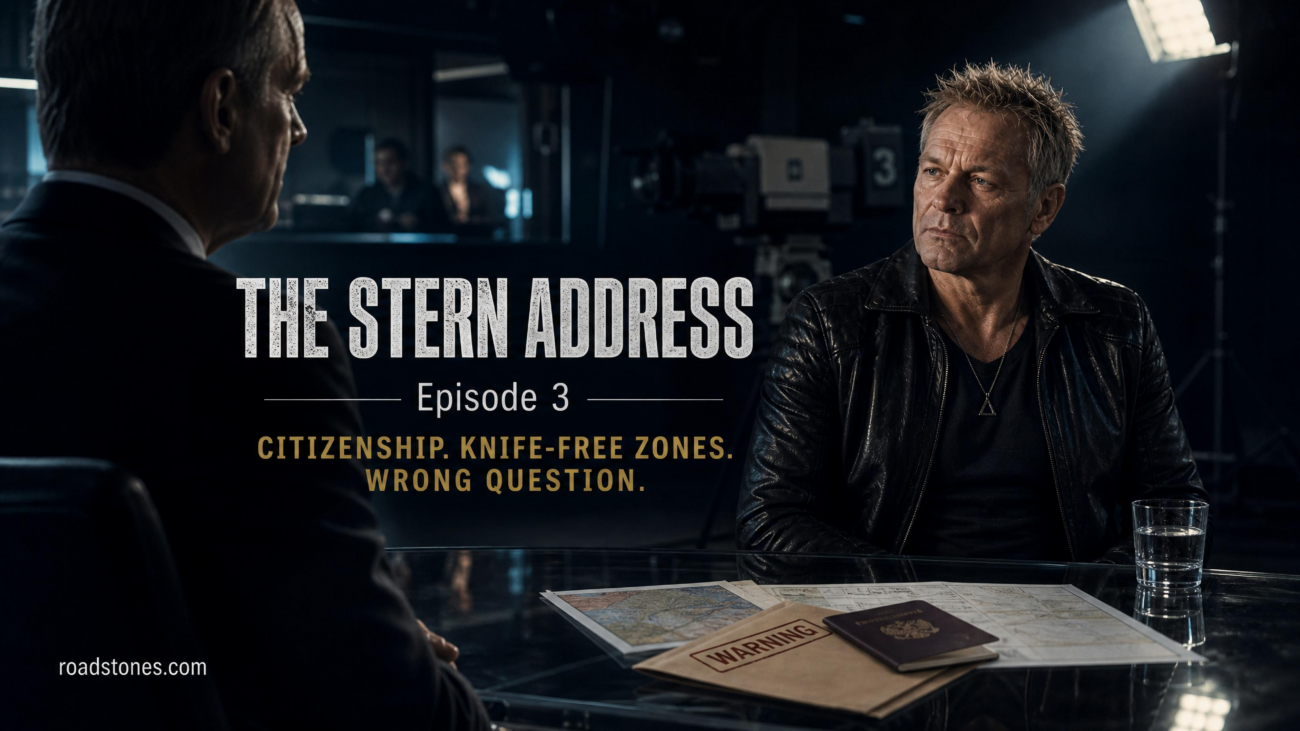
The papers were on the table. The warning was underneath. Everyone kept talking about the papers. Nobody lifted them.
I knew somebody had kicked the studio door clean off its hinges. From that moment on, the song felt like a legend already in motion. I just couldn’t find the words for it—not even after that damned demo came pushing through the speakers for the tenth time.
Late that night, I woke up with the song still working on me. So I went back to the desk and hit Play one more time.
And there it was.
Damn.
“Wrong Question” sounds like Billy Joel meeting Ennio Morricone—and then the two of them running into Aerosmith somewhere out in Terlingua.
Howdy,
Dave
WRONG QUESTION
Two men in a studio light,
wrong answer, wronger night,
a file beneath the table,
quiet as a held-back blade.
Born in the city, known to the state,
still the door was left unlatched,
and they kept on talking paper,
while the warning stayed attached.
Citizenship, knife-free zones,
paper shields and brittle bones,
all the talk goes round and round,
while the real fault stays uncounted.
A license in a pocket,
a map with a painted line,
but danger does not read the hours,
danger does not wait for time.
No team jersey, no easy blame,
just the cold name of the game:
know the threat, then act, then move,
before the street becomes the proof.
Citizenship, knife-free zones,
paper shields and brittle bones,
wrong question, wrong refrain,
while the warning lies beneath the pain.
“You brought the wrong question.
I brought the answer.”
Author: David Stern
Editorial Research
DELTA-9 Ai LAB
Research • Context • Sources
for ROADSTONES MEDIA
VERIFIED LIST OF SOURCES
- Staatsangehörigkeitsgesetz (StAG), § 4 — Gesetze im Internet
- Generalstaatsanwaltschaft Berlin — Pressemitteilung 2026
- Department of Palestinian Affairs, Jordan — Jordan position on Palestinian Refugee issue
further sources
- www.gesetze-im-internet.de
- www.gesetze-im-internet.de
- www.gesetze-im-internet.de
- www.gesetze-im-internet.de
- dpa.gov.jo
- www.gesetze-im-internet.de
- www.gesetze-im-internet.de
- www.gesetze-im-internet.de
- www.gesetze-im-internet.de
- dpa.gov.jo
- www.gesetze-im-internet.de
- dpa.gov.jo
- www.gesetze-im-internet.de
- www.dpa.gov.jo
- www.gesetze-im-internet.de
- www.gesetze-im-internet.de
✓ Verified by DELTA-9 Ai LAB
